This is a personal skills showcase, not a client project. It was completed as the capstone for the IBM Applied Data Science with R course on Coursera. It is presented here transparently to demonstrate practical R and data science capability.
Demand and supply rarely match
Urban bike-sharing systems regularly face a mismatch between bike availability and rider demand. During peak periods, stations run empty; during quiet periods, bikes sit unused. Operators need accurate demand forecasting to redistribute bikes efficiently and reduce both shortages and waste.
The goal of this project was to build a predictive model for hourly bike rental demand using weather and time-of-day data, and to make that model accessible through an interactive dashboard.
What drives demand
Temperature dominates
Strong linear correlation with demand across all seasons. Usage drops dramatically below 0°C regardless of time of day.
Commuter-driven peaks
Clear 8am and 6pm usage spikes indicate transport-focused demand. Evening leisure use extends peaks to 10pm in summer.
Rainfall matters most
Rainfall and humidity are the strongest individual predictors — cyclists avoid wet conditions above all else.
Seasonal patterns in the data
Hourly rental counts across 2018 show a clear seasonal pattern — minimal usage in January and February, building to 3,500+ rentals per hour at the summer peak in June–August. The dense clustering of points reflects daily commuter rhythms layered on top of the seasonal trend.
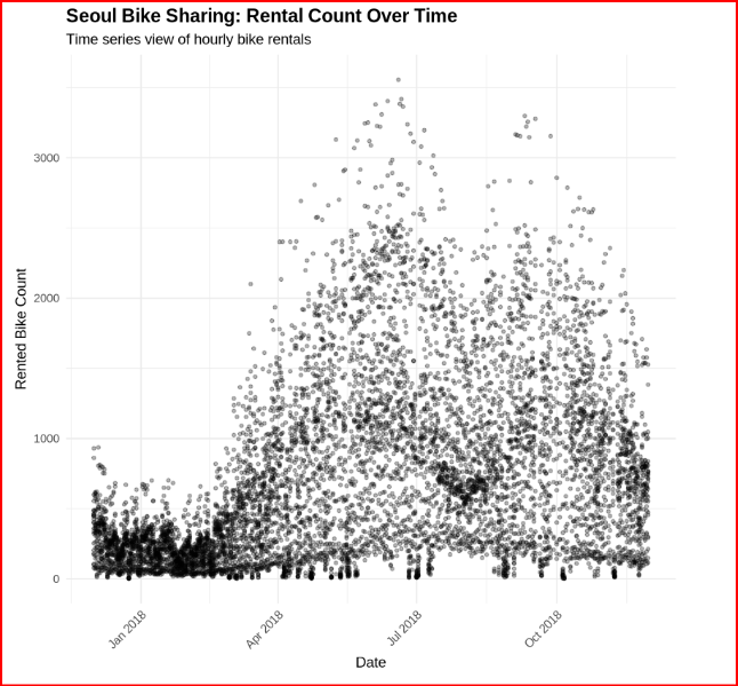
Seoul Bike Sharing: hourly rental count over time (2018)
Which variables matter
Ranked regression coefficients confirm that rainfall and humidity are the strongest predictors of demand, followed by temperature and specific commuter hours. Wind speed and visibility have minimal effect — cyclists tolerate these conditions but not wet or extreme cold.
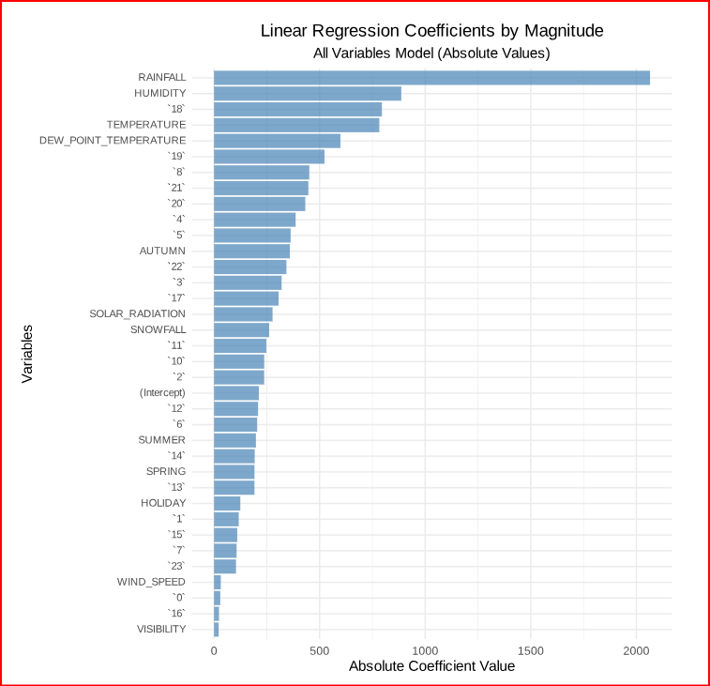
Linear regression coefficients by magnitude — all variables model
Five models compared
Five regression models were developed and evaluated, starting from a baseline linear model and progressively adding polynomial terms, interaction effects, and regularisation. All models exceeded the performance thresholds of R² > 0.72 and RMSE < 330 bikes.
The best performing model — Elastic Net with complex weather interactions — achieved R² = 0.82 and RMSE of 280.8 bikes, successfully capturing the non-linear relationships between weather conditions and demand.
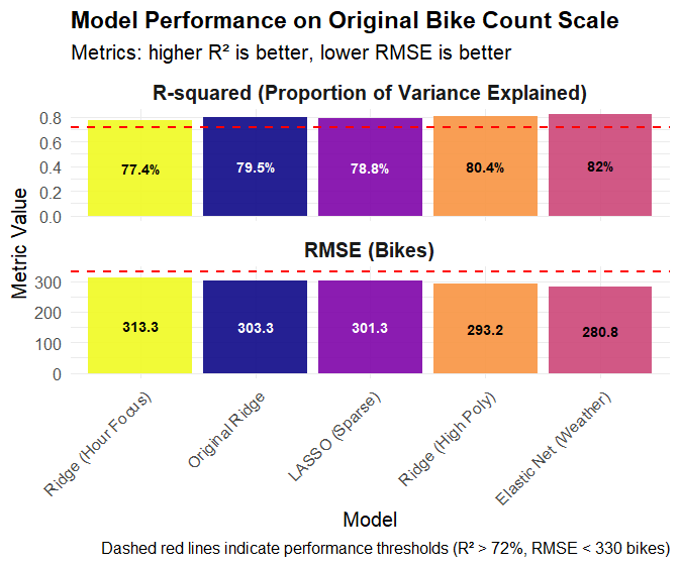
Model performance comparison — R² and RMSE across all five models
Real-time demand forecasting
The project culminates in an R Shiny dashboard that applies the Elastic Net model to generate live demand forecasts for cities worldwide. Users can select a city from the interactive map, view current weather conditions, and explore 5-day temperature and demand prediction trends. The dashboard integrates live data from the OpenWeather API.
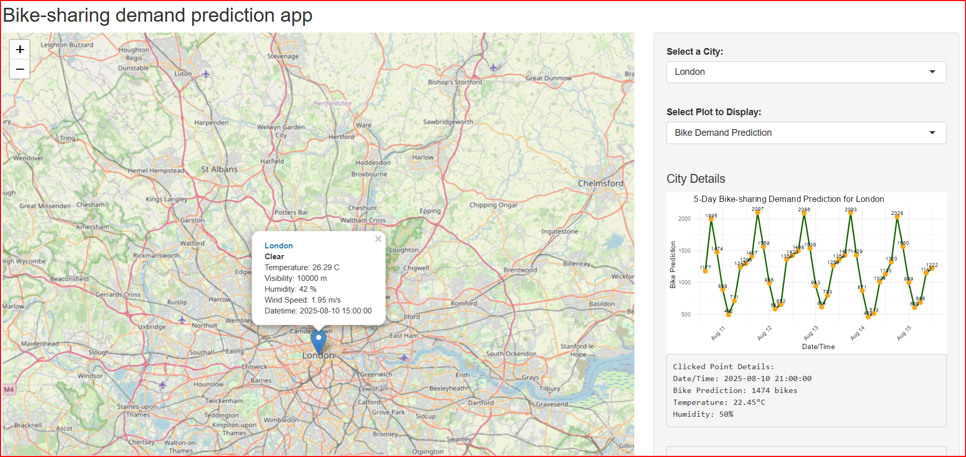
R Shiny dashboard — city selection, live weather data, and 5-day demand forecast